GPS Maps Navigation Directions
- 4.3
- Rating
- 500.00K
- Installs
- Free
- Price
 Analysis by App-foxy
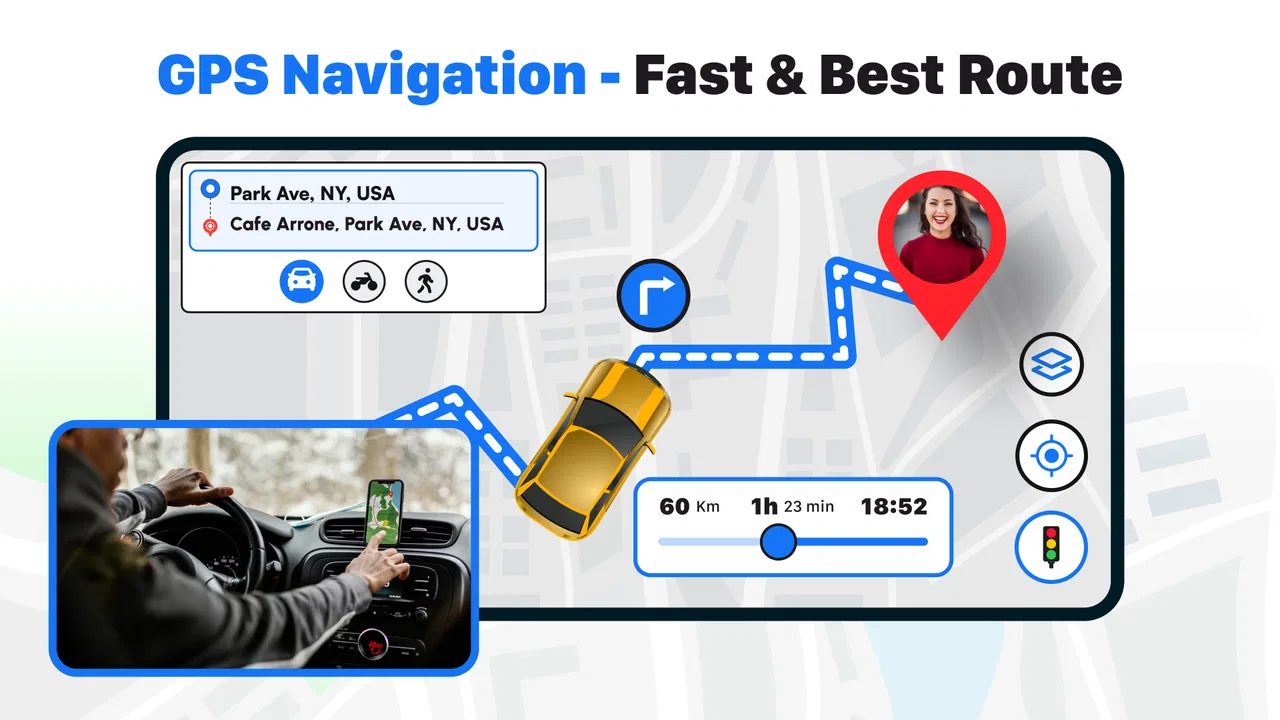
GPS Maps Navigation Directions is the kind of app I would try during a busy week when I want a straightforward navigation tool without paying an upfront fee. It sits in the Maps & Navigation category and comes from Quix Technologies LLC. The basic promise is easy to understand: use GPS maps, listen to voice guidance, and follow driving directions while travelling. After spending time with it, I see its appeal less as a complete replacement for every navigation service and more as a focused option for people who want a simple route companion.
The first impression is helped by the fact that the app is free to install and is rated for Everyone. That makes it approachable for a family device, a spare phone, or someone who only occasionally needs turn-by-turn help. Its average rating is 4.1 from over 500 ratings, while the app has passed 50 thousand installs. Those figures suggest a modest but real user base rather than a tool that has already become a default choice for most drivers.
A useful first week, especially for occasional drivers
During the first few days, the strongest part of the experience is the low barrier to getting started. The short description, “GPS Maps,” is extremely brief, but the actual purpose is clearer once the app is open: it is designed around finding a route and following it with spoken instructions. I appreciate that focus because navigation is one of those tasks where too many extras can become distracting, particularly when I am already trying to watch traffic and road signs.
You May Also Like

 Blood Strike: 2.5 Anniversary
Blood Strike’s Loadouts Turn Every Drop Into a Tactical Gamble
A close look at Blood Strike’s custom loadouts: how fast access to signature weapons reshapes its battle royale rhythm, rewards preparation, and narrows the gap between fights.

 Pandora - Music & Podcasts
Pandora’s Music Is Easy to Start, but Harder to Recover
Pandora’s strength is its low-effort path from a seed to a station. Its weak spot is how much confidence it asks you to place in connection, setup, and quiet recovery.

 8 Ball Pool
 Is Built on Rivalries, Rematches, and Routine
A close look at the rivalries, rematches, shared routines, and unanswered safety questions that turn a quick pool match into a persistent mobile community.

 Samsung Music
’s Quiet Strength Is Playing What You Already Own
Its reach comes less from spectacle than from dependable access to a personal library. That simplicity is both the app’s strongest retention engine and its ceiling.

 AccuWeather: Weather Radar
AccuWeather Review: A Quick, Clear Forecast for Everyday Decisions
For everyday plans, the best forecast is the one you can understand quickly. AccuWeather makes rain timing, radar, and local conditions easy to act on, with a few trade-offs.

 Hill Climb Racing
Why Hill Climb Racing Still Turns Crashes Into One More Run
A tiny car, a bumpy hill and one more upgrade: Hill Climb Racing keeps resurfacing because its simple chaos makes every near-miss feel personal.
More From Our News Desk



For a new user, the most sensible way to test it is on a familiar trip rather than an important journey. I would enter a regular commute, compare the suggested route with the roads I normally use, and listen to how the voice guidance fits around real driving conditions. This first run reveals something more important than a polished first screen: whether the directions arrive early enough for the way I drive and whether the map remains easy to read at a glance.
A realistic use case is a weekend visit to a nearby town. I might know the first part of the route but not the final streets, so I would use the app for the unfamiliar section while keeping an eye on physical signs. That is where voice navigation earns its place. I do not need to keep touching the screen, and I can concentrate on junctions instead of repeatedly checking a written list of instructions.
The app also makes sense for someone who has just changed phones or keeps an older device in the car. It supports Android 7.0 and later, which gives it a relatively broad reach among older Android hardware. I would still test the phone at home before relying on it in traffic, because navigation depends on the complete combination of handset, GPS reception, audio volume, and the driver’s mounting position—not simply on installing the application.
What makes the early experience appealing
The main attraction is clarity. A dedicated navigation app can be easier to understand than a larger mapping platform packed with reviews, recommendations, business information, and other layers. If all I want is a map and driving guidance, a narrower interface may reduce the number of decisions I have to make before leaving.
Voice instructions are particularly useful when the phone is mounted low or slightly out of view. I would treat them as a second channel rather than a replacement for road awareness. Spoken directions can tell me that a turn is approaching, but I still want to confirm lane markings, signs, and the actual shape of the junction. That habit is important with any navigation app, and it prevents a confident-sounding instruction from becoming an unsafe command.
Another practical advantage is the free entry point. I can install GPS Maps Navigation Directions, try it on ordinary trips, and decide whether it fits my routine before spending anything. In-app purchases range from $0.99 to $18.99 per item, so I would pay attention to any optional purchase screen and make sure I understand what an item adds before approving it. The free starting point is valuable, but it does not automatically mean every useful capability is included without cost.
How GPS Maps Navigation Directions holds up after the novelty
After the novelty wears off, I judge GPS Maps Navigation Directions by whether it still makes a real trip easier, not by how quickly I learned its basic purpose. I’d keep it in rotation for occasional unfamiliar drives and compare its prompts against roads I know before trusting it on a demanding journey. That kind of repeat use also reveals whether its focused approach suits different needs and situations.
Month-to-month value depends on routine
Navigation apps are judged differently from games or creative tools. I do not open them because I want entertainment; I open them because I have somewhere to go. That means lasting value comes from reliability, quick access, and a guidance style I can trust. If this app consistently helps me with unfamiliar destinations and occasional route checks, it can remain useful even when I stop noticing its presence.
For a driver who makes similar trips every week, the value may be limited after the initial learning period. Once I know my commute, I may not need a navigation app at all unless traffic, road changes, or an unexpected detour makes the normal route unsuitable. In that situation, a larger mapping alternative may be better if I want extensive live local information, business discovery, transit planning, or a broad ecosystem around maps.
GPS Maps Navigation Directions is more convincing for irregular travel. I can imagine keeping it available for appointments in unfamiliar areas, visits to clients, holiday driving, or the last part of a journey where the main roads are easy but the destination streets are not. The app’s recurring value comes from being ready when memory fails, not from demanding daily attention.
There is also a useful distinction between a primary navigator and a backup. I would be comfortable testing this app as a secondary option on a spare phone or for low-pressure trips. That lets me learn its behavior without making an important journey the first serious test. Once I know how its voice prompts and route display work, I can decide whether it deserves a more central role.
Small habits that improve the experience
I recommend setting the destination before pulling away, checking the route while parked, and making sure the spoken guidance can be heard over the car’s normal noise. These are ordinary steps, but they matter more with a focused GPS tool because the app is only helpful when the driver has prepared the phone and understands what to expect.
One less obvious tip is to use familiar roads as calibration trips. A route that I already know gives me a safe reference for judging whether instructions feel early, late, or appropriately timed. I can also notice whether the map’s visual emphasis makes sense at complex intersections. This is more useful than judging the app from a single impressive long-distance drive.
I would also avoid treating the suggested route as automatically superior to local knowledge. A route can look efficient on a screen while being awkward because of lane arrangements, temporary restrictions, school traffic, or a turn that is difficult to make safely. The best workflow is to let the app handle the navigation workload while I remain responsible for checking the road itself.
Maintenance is light, but attention still matters
The app’s current version is 1.39, and it was released on September 5, 2025. Those details matter mainly because navigation software needs to remain a living tool. Roads change, operating systems evolve, and users develop expectations about how directions should be presented. I would keep an eye on updates through the normal app store process rather than installing it once and forgetting about it indefinitely.
Maintenance is not only about updates. I would periodically check that the app still opens correctly on the phone I use in the car, that location access works as expected, and that the voice output is routed to the right speaker. I would do this before a long trip, not while already leaving a crowded car park. A navigation app can seem perfectly fine at home and still become frustrating when the phone is connected to a different audio setup.
Keeping the phone charged is another practical part of maintenance. GPS use can be demanding over a long drive, and a low battery turns even a good navigation app into a poor travel plan. I would keep a charging cable in the car and position the phone where the screen is visible without blocking the driver’s view. These are not special features of this particular application, but they determine whether its central purpose works in daily life.
The optional purchase range also creates a maintenance question for my own budget. Since the app is free but offers items from $0.99 up to $18.99, I would review purchases as a recurring decision rather than assuming that paying once transforms the whole experience. If I only need occasional directions, the free starting point may be enough. If I use it frequently, I would want to understand the practical benefit of any paid item before making it part of my routine.
Where long-term fatigue can appear
The first source of fatigue is repetition. If I already use another map service every day, adding a second navigator means remembering which app contains which places, which interface I trust, and which one I should open before leaving. A new navigation app can feel refreshing for a week, but that novelty does not automatically create a lasting habit.
The second is uncertainty around route expectations. Drivers often want more than a line from one point to another. They may care about traffic conditions, nearby stops, detailed place information, alternative travel modes, or a familiar history of saved locations. GPS Maps Navigation Directions presents a narrower proposition, so someone who expects a full mapping ecosystem may find it less satisfying than a well-established alternative.
Voice guidance can also become tiring if the timing or frequency does not match personal preference. Some drivers want frequent reassurance; others prefer only essential prompts. I would judge this on several ordinary trips, because one route with many junctions can give a misleading impression. If the spoken instructions make me look at the screen more often rather than less, the app is working against its most useful purpose.
Another trade-off is the danger of overconfidence. A clean map and a calm voice can make a route feel authoritative, but neither replaces attention to changing road conditions. I would never use the application as a reason to ignore signs or make a sudden maneuver. For me, a navigation app earns long-term trust by supporting careful driving, not by encouraging blind obedience.
Who should use it, and who should choose something else
I think this app is best suited to occasional drivers, people who want a straightforward GPS companion, and users who prefer trying a free tool before considering optional purchases. It may also appeal to someone with an older Android phone, provided the device runs Android 7.0 or newer and performs well enough for navigation. The Everyone age rating makes it a practical option for general household use, although every driver still needs to use it responsibly.
I would be more cautious about recommending it as the only navigation solution for someone who drives professionally, travels through unfamiliar regions constantly, or expects a large collection of connected map services. In those cases, an established alternative with the specific live information or planning tools that person depends on may be a better fit. The right comparison is not simply which app looks cleaner; it is which one reduces work during the trips that happen most often.
I would also skip making it my main choice if I dislike switching between navigation tools. Maintaining two apps can create its own friction, especially when one is already familiar and dependable. The free installation makes experimentation easy, but a trial is only worthwhile if I give it a genuine role—such as handling weekend trips or acting as a backup—instead of opening it once and expecting an instant reason to change habits.
My long-term verdict
After the first-week appeal fades, GPS Maps Navigation Directions remains interesting because it is focused and accessible rather than because it tries to be everything at once. I like the idea of a free GPS app with voice directions that can be tested on ordinary trips, and the current 4.1 average shows that many users find enough value to rate it positively. Still, its lasting place on my phone would depend on how naturally it fits into my existing travel routine.
My recommendation is to treat it as a practical trial, not an automatic replacement for the navigation service you already know. Test it on familiar routes, then use it for a few low-pressure unfamiliar destinations. Listen carefully to the prompts, observe the map at complicated turns, and decide whether it actually makes driving calmer. That process reveals more than the first launch screen.
The real test is whether it saves attention month after month, not whether it feels new on day one. For occasional journeys and simple driving guidance, it has a reasonable case. For drivers who need a broad, information-rich mapping platform every day, another option may offer better long-term value. I would keep GPS Maps Navigation Directions installed if its voice instructions proved dependable on my regular trips, but I would not force it into a permanent role simply because it is free.
FAQs for GPS Maps Navigation Directions
01What features does GPS Maps Navigation Directions offer?
GPS Maps Navigation Directions provides real-time traffic updates, turn-by-turn navigation, and offline maps. It also includes features like route planning for walking, driving, and biking, along with point-of-interest search and speed limit alerts. Users can customize routes and explore various map views to enhance their navigation experience.
02Is GPS Maps Navigation Directions available offline?
Yes, GPS Maps Navigation Directions offers offline functionality. Users can download specific regions or countries to access maps without an internet connection. This feature is particularly useful for traveling in areas with limited connectivity, ensuring uninterrupted navigation and saving on data usage while on the road.
03How accurate is the real-time traffic information?
The app provides highly accurate real-time traffic updates by using data from various sources, including user reports and traffic cameras. It offers live updates on congestion, accidents, and road closures, helping users choose the fastest and most efficient routes to their destinations, thus saving time and avoiding delays.
04Does GPS Maps Navigation Directions support multiple languages?
Yes, the app supports multiple languages, making it accessible to a global audience. Users can choose their preferred language for voice guidance and interface settings, ensuring a personalized and user-friendly navigation experience regardless of their linguistic background.
05Are there any in-app purchases or subscription fees?
While GPS Maps Navigation Directions is free to download, it may include optional in-app purchases or subscription services. These can provide access to premium features such as advanced traffic data, ad-free experience, and enhanced map options. Users should review these options to determine if they are necessary for their needs.
Pros
- User-friendly interface
- easy navigation.
- Accurate real-time traffic updates.
- Offline maps for data saving.
- Voice-guided directions available.
- Customizable route options.
Cons
- Occasional GPS signal loss.
- Ads can be intrusive at times.
- High battery consumption.
- Limited support for rural areas.
- In-app purchases can be pricey.

GPS Maps Navigation Directions
Gallery